BoardBrain
Request a briefingBriefing
Sector Review · Initiating report · Q2 2026

Big Oil should make its promises at $90, not at $70.

The market rewards dated, quantified commitments. Boards have a narrow window to turn a temporary windfall into durable credibility.

ExxonMobil, Chevron, Shell, TotalEnergies, ConocoPhillips, EOG Resources, Occidental, Diamondback Energy, Devon Energy and BP. Published 25 July 2026, days before the sector reports.

98results days and strategy presentations measured since 2024
1,847analyst questions parsed across the ten companies
388earnings-call prepared-remarks segments read in full
22/24best-received events carried a new, dated commitment
The argument

A promise made from surplus cash reads as conviction. The same promise at $70 reads as a concession.

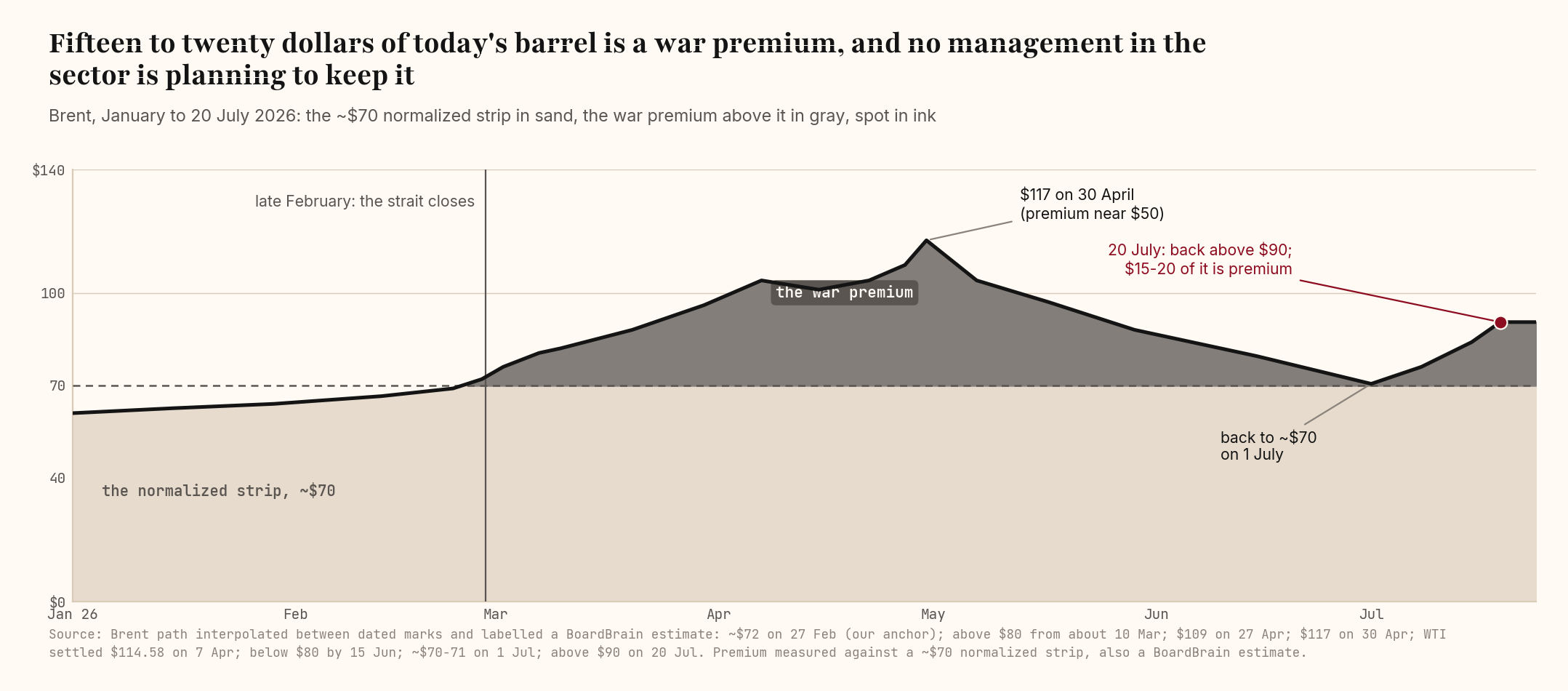
Oil is above $90, but none of the ten companies treats today’s price as its planning assumption. They are probably right. At the end of April the premium was worth nearly $50 a barrel, and within two months it had gone. A premium can disappear faster than a board can reset a capital framework.

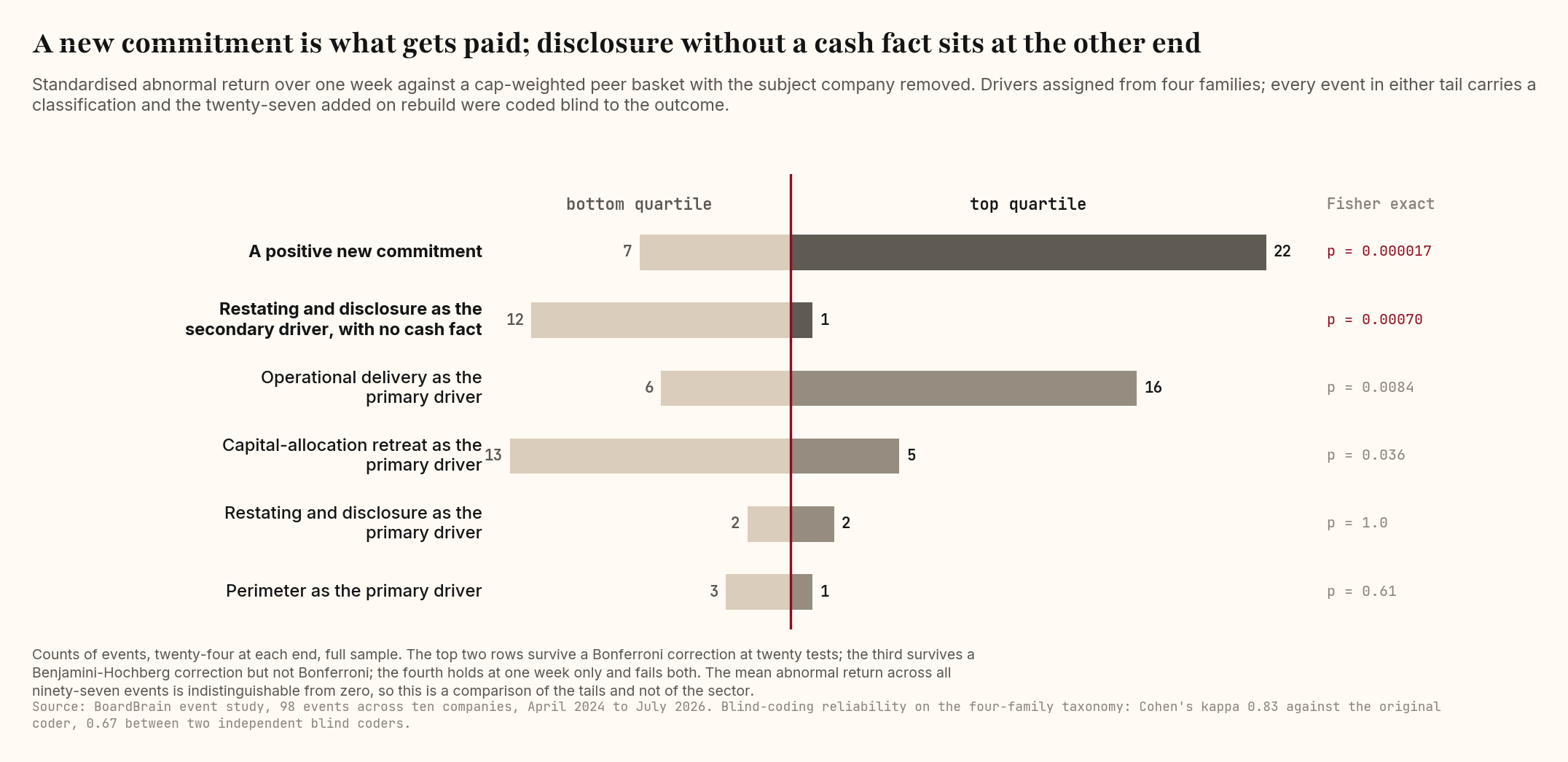
That creates a narrow credibility window, and the market has already shown what it will pay for inside it. Of the 98 results days and strategy presentations these companies have held since 2024, the 24 best received a week later included 22 that carried a new, dated commitment. Among the 24 worst, seven did. The odds against a difference that large arising by chance are about 2 in 100,000.

The opposite is priced too. Presentations that restated the strategy without attaching a cash or capital number appeared once among the 24 best days and 12 times among the 24 worst. A results day given over to narrative is not a neutral use of the calendar. It is a small and measurable cost.

What separated the best reactions from the worst across ninety-eight measured events, one week, against a basket of sector peers.
What separated the best receptions from the worst. Twenty-four events at each end of the distribution. A new commitment at the top; disclosure with no cash fact attached at the bottom.
The visibility problem

Boards are asking the market to believe things about years the market has largely stopped forecasting.

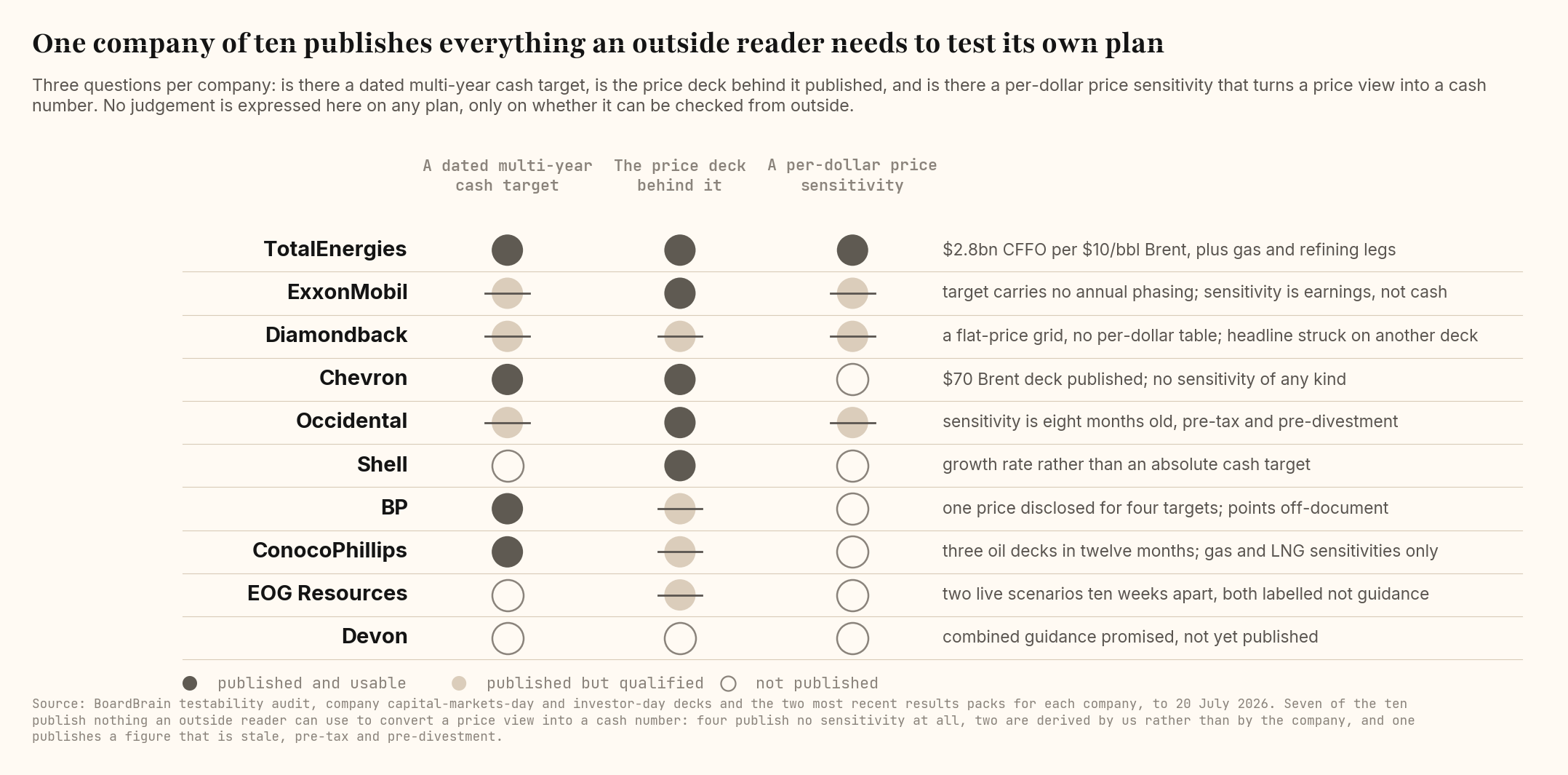
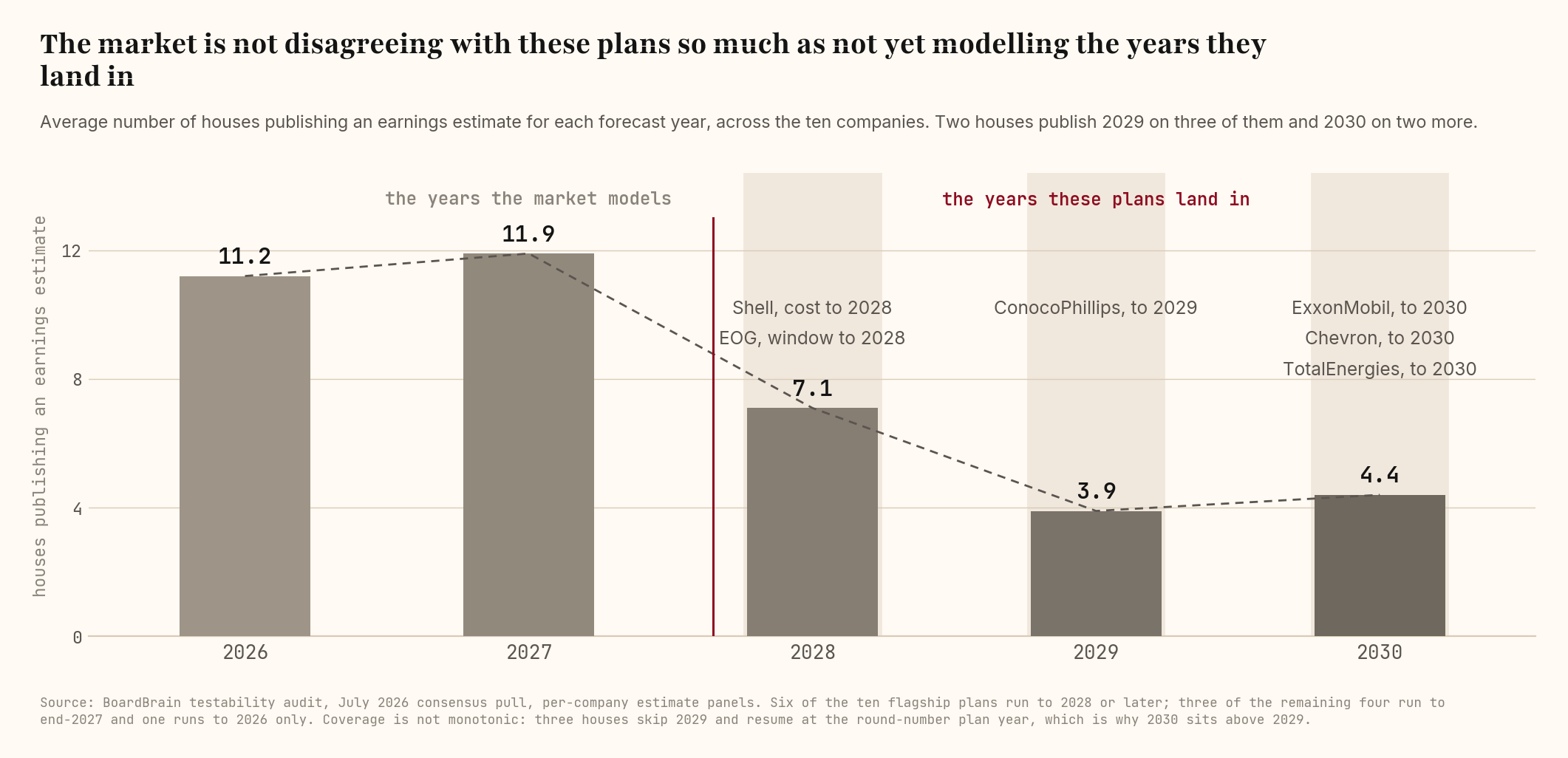
Analyst coverage falls from an average of 11.9 houses per company for 2027 to 7.1 for 2028, yet six of the ten flagship plans extend to 2028 or beyond. And seven of the ten publish none of the three things an outsider needs to stress-test a plan: a dated cash target, the commodity-price assumption beneath it, and a per-dollar price sensitivity. One company publishes all three.

Should Brent return to its $70 strip, some $25bn to $35bn of annual sector cash flow goes with it, and most of these plans cannot be tested for that from outside the building.

Houses publishing an earnings estimate, by forecast year, averaged across the ten companies.
Coverage roughly halves between 2027 and 2028, and halves again by 2029 — in the years most of these plans are built around.
The testability audit: a dated multi-year cash target, the price deck behind it, and a per-dollar sensitivity, company by company.
Three questions per company, answered only from what each company publishes. Only one of the ten answers all three.
The premium

Fifteen to twenty dollars of today’s barrel is a war premium, and not one company has re-anchored its planning price.

Against a normalised strip of about $70, we estimate $15 to $20 of the current barrel is pure war premium. At the late-April peak it was nearer $50. Ten management teams have reached the same judgment in public: the current price is not a planning assumption.

The war premium decomposed: Brent against the approximately seventy dollar normalised strip, January to July 2026.
The war premium, decomposed. Brent against the ~$70 normalised strip, January to 20 July 2026.
The question

Which of this year’s decisions would look different at $70, and have shareholders been told which ones?

The useful question for a board this season is not what price it is planning on. Companies that answer in public, with a figure, convert a temporary windfall into something more durable, which is guidance that investors believe. Those that do not will be asked the same question next year, with less cash in hand and less control over the terms.

Method

How this issue was built

The corpus is 388 earnings-call prepared-remarks segments and 108 investor-day and results decks across the ten companies, roughly 1.5 million words of management text, together with 1,847 parsed analyst questions, the companies’ filings and the sell-side record. The newest document of any kind is dated 20 July 2026.

The event study covers 98 events from April 2024 to July 2026. Abnormal returns are computed on a market model estimated over the 120 trading days ending fifteen days before each event, standardised by the cumulative prediction-error variance, and measured against a benchmark that excludes the subject company. Every horizon is reported side by side. European names are measured on their primary listings in local currency.

Six limitations are printed in the issue rather than left to be discovered, including that the mean abnormal return across all events is indistinguishable from zero on every measure, so this is a study of tails and not of a typical results day. Driver classification was re-coded blind to the price outcome, and the two variables that did not reproduce under blind coding are demoted with their reliability statistics shown.

A per-company valuation chapter was attempted for this issue and withdrawn in full. The anchor entry inverted once the chief financial officer’s actual guidance timing was read correctly, the largest entry double-counted a saving already inside the consensus earnings line, and five of nine entries were negative before any test was applied. The chapter was replaced by the testability audit. The full account is in the revisions note at the back of the issue.

Notice

Important notice

This review is published by BoardBrain as general commentary on a sector. It is not investment research, it is not a personal recommendation, and it is not an offer or solicitation to buy or sell any security. Nothing in it should be relied on in making an investment decision. Readers who want advice should take it from someone regulated to give it, having regard to their own circumstances.

Every figure is derived from information the ten companies have themselves published, or from market prices, and the sources are set out in the appendix to the issue. Where a figure is recomputed by BoardBrain rather than taken as reported, that is stated. Where an association is not established as a cause, it is labelled as an association. Where the evidence cannot settle a question, the review says so.

As at the date of publication, BoardBrain holds no position in any security mentioned, takes no banking mandates, and received no payment from any of the ten companies in connection with this review. BoardBrain is a research and advisory business. It may in future hold positions in, provide advisory or analytical services to, or receive compensation from any company covered in this issue, and it may publish opinions, ratings or valuation work on them. Any such work will carry its own disclosures. Nothing here should be read as an undertaking that no relationship will arise, and the absence of one today does not imply its absence later.

The absence of ratings, price targets and valuation judgements in this issue is a decision about this issue. It is not a statement about what BoardBrain publishes elsewhere or may publish in future.

What this issue does not contain

This issue carries no ratings, no price targets, no share-price predictions, no per-share or percentage-of-market-capitalisation value figures for any company, and no valuation of any company. Those are recommendations in substance whatever the disclaimer says, and they would change who may lawfully receive it. Where an enterprise-value multiple appears in the scorecard it is reported as an observed market fact on a stated common basis, not as a judgment that any company is cheap or expensive.

Timing

The state of the world in this document is 25 July 2026. Company evidence stops at each company’s own most recent results, which fall on different dates, and the newest document of any kind in the corpus is dated 20 July 2026. Market data stops on 22 July 2026. Nothing has been updated for events after those dates and no undertaking is given to update it. Several of the ten report within days of that date, so the as-at date should be read strictly.

Reproduction

Every figure traces to a saved artifact. Event-level records, per-company benchmark rows, the theme lexicon with its precision checks, the analyst registry, the blind coding records and both coders’ independent codings are all retained. Every quotation in the issue was verified against the corpus by exact string match before publication.
We read the sector so that we can read your company. This is the half we publish.

Request a briefing on your own company All issues