In 2017, 9% of the consumer initiatives these eight companies presented repeated a move a peer in the group had already made. In 2026 the figure is 76%. Value is moving to distinct occasions, scarce routes to market and funded plans — and away from pricing, imitation and the undifferentiated centre of the store.
PepsiCo, The Coca-Cola Company, Monster Beverage, Celsius Holdings, Constellation Brands, Kraft Heinz, Mondelez International and General Mills. Published 6 August 2026.
In 2017, 9% of the consumer initiatives these eight companies presented in their own capital-markets material repeated a move a peer in this group had already made. In 2026 the figure is 76% — 67 of 88 coded initiatives, at a median follow lag of three years. Across the eleven-year record, the shortest interval between a peer’s move and its copy was two days.
The category data show where converged offers end. In nonflavored bottled water, private label is the number-one “brand” at 36.5% of segment dollars. In energy drinks, private label is close to zero and the top five branded producers hold over 90% of the category. The pairing is an association between offer convergence and private-label share, not proof that one causes the other — the review sets out the full reasoning.
Meanwhile three companies cut or under-delivered advertising while their published plans targeted share gains. Mondelez cut advertising 21.6%. PepsiCo cut it 12.8%, taking total advertising and marketing to a decade-low 5.75% of revenue. On the other side, General Mills raised advertising 51.7% since fiscal 2018, and Kraft Heinz guided its own operating income down 14–18% to fund roughly $600m of reinvestment.
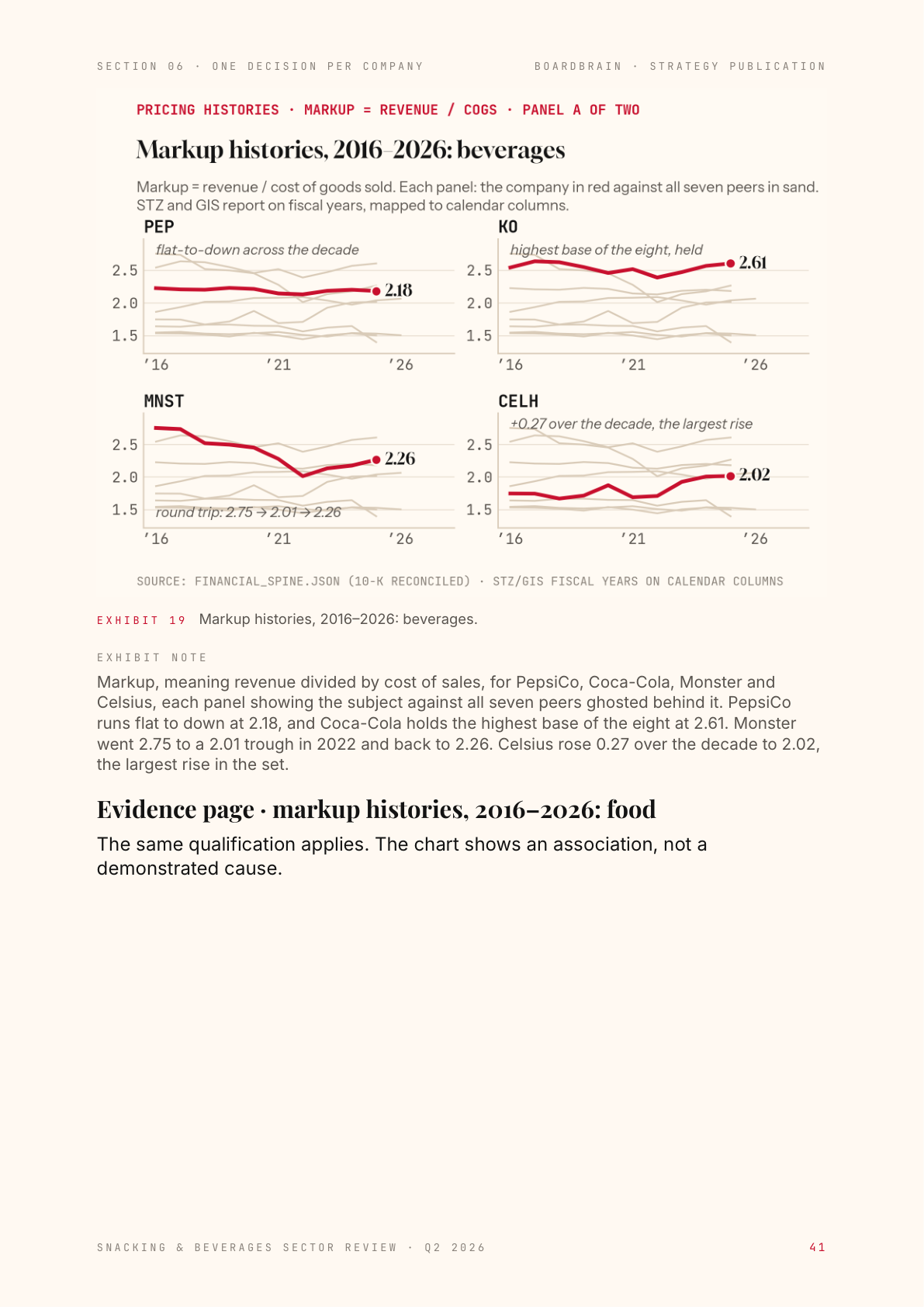
Position in the value chain is priced in the audited numbers. The two ends of one franchise system out-earn every owner-operator in this peer set: markups, measured as revenue over cost of goods on one consistent basis, run 2.61 at Coca-Cola and 2.26 at Monster, which also earns the set’s highest return on invested capital at 21.7%. The warehouse-delivered portfolios, Kraft Heinz and General Mills, carry markups near 1.50, flat for a decade.
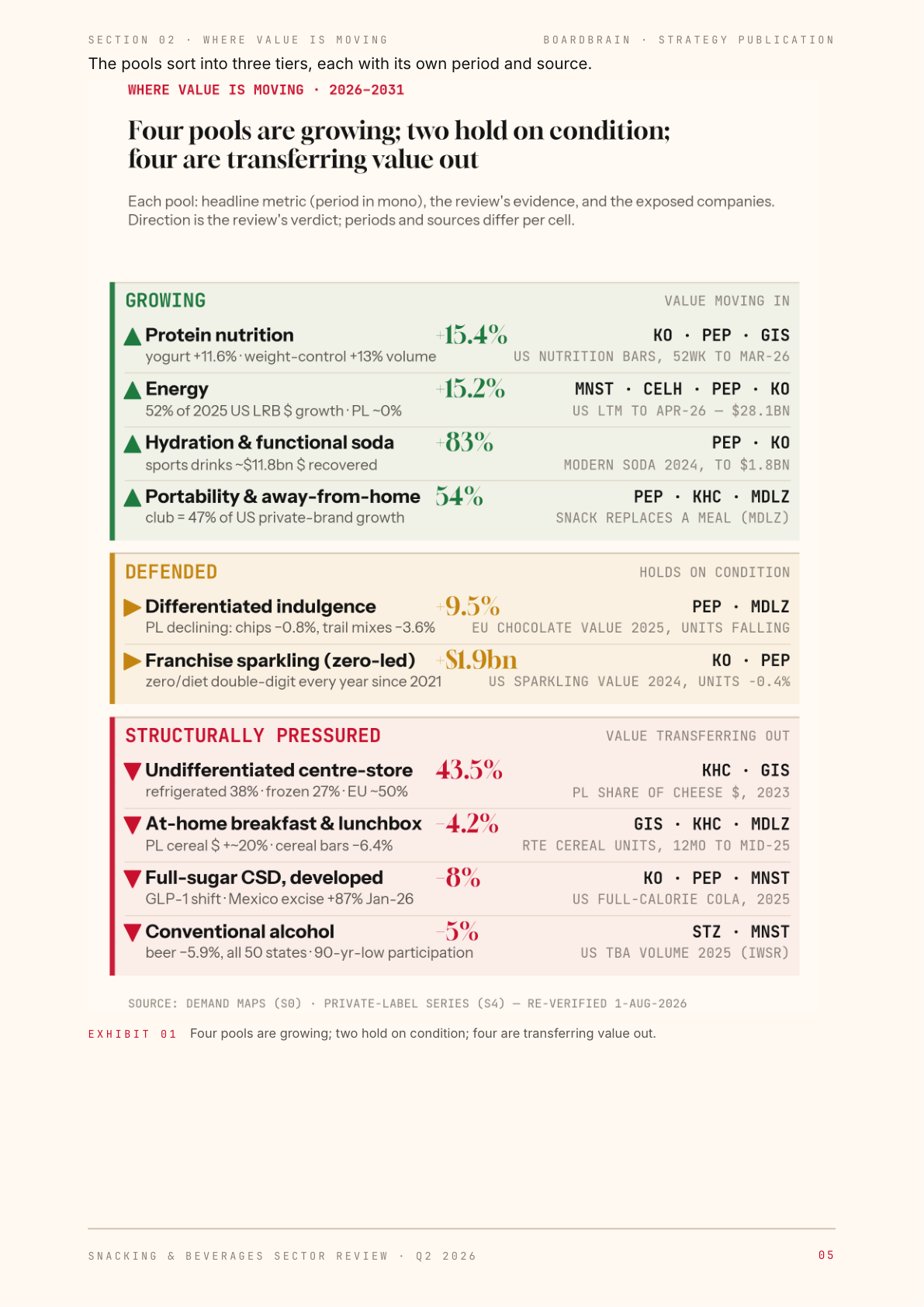
Over that same decade retailer gross margins rose, and US retail media added roughly $69.3bn of retailer revenue in 2026. Which party captured which part of the chain’s margin growth is not separately disclosed — and none of the eight companies has named retail media once across 503 earnings-call transcripts since 2012. Private label has reached 43.5% of US cheese dollars, and its adoption is fastest among higher-income households, which is why the review argues the share may not return automatically to brands when the economy recovers.
One. The sector thesis: value is shifting toward companies that win distinct occasions, secure scarce routes to market and fund those priorities consistently.
Two. Where demand and profit pools are moving, 2026–2031: four pools growing, two holding on condition, four transferring value to retailers, private label or other categories.
Three. The three questions that most separate the eight: distinctive occasions versus imitation, privileged access to a scarce route to market, and funded choices versus unfunded ambition.
Four. Four business-model archetypes the evidence supports, and what each requires to work.
Five. The eight companies on one strategic map, on one basis.
Six. One strategic decision per company: eight decision pages, each with the evidence, the boundary and the test.
Seven. Implications for boards over the next 24 months: three disciplines a board can adopt now.
This review is published by BoardBrain as general commentary on a sector. It is not investment research, it is not a personal recommendation, and it is not an offer or solicitation to buy or sell any security. Nothing in it should be relied on in making an investment decision. Readers who want advice should take it from someone regulated to give it, having regard to their own circumstances.
Every figure is derived from information the eight companies have themselves published, from named third-party data providers, or from market prices, and the sources are set out in the accompanying evidence book. Where a figure is a bounded estimate derived in the analysis it is tagged as an estimate, and where it is BoardBrain’s reading of the evidence it is tagged as judgement. Where an association is not established as a cause, it is labelled as an association. Where the evidence cannot settle a question, the review says so.
As at the date of publication, BoardBrain holds no position in any security mentioned, takes no banking mandates, and received no payment from any of the eight companies in connection with this review. BoardBrain is a research and advisory business. It may in future hold positions in, provide advisory or analytical services to, or receive compensation from any company covered in this issue, and it may publish opinions, ratings or valuation work on them. Any such work will carry its own disclosures. Nothing here should be read as an undertaking that no relationship will arise, and the absence of one today does not imply its absence later.
The absence of ratings, price targets and valuation judgements in this issue is a decision about this issue. It is not a statement about what BoardBrain publishes elsewhere or may publish in future.
This issue carries no ratings, no price targets, no per-share or percentage-of-market-capitalisation figures for any company, and no comparative valuation language. Those are recommendations in substance whatever the disclaimer says, and they would change who may lawfully receive it.
The state of the world in this document is 6 August 2026. All figures were re-verified against their sources on 1 August 2026. Several companies report within weeks of publication, so the as-at date should be read strictly.
Every number in this publication is drawn from the accompanying evidence book, Snacking & Beverages Sector Review, Q2 2026, which carries the sources, methods and company chapters. Quotations are verbatim from named company documents and were verified against those documents before publication.