BoardBrain
Request a briefingBriefing
Sector Review · Initiating report · Q2 2026

The sector grew its revenue and lost its shareholders money.

Seven years, a median return of minus thirty-eight per cent, and a three-hundred-and-forty-five-point spread between the best and the worst. One line of the income statement explains most of it.

NIKE, adidas, Ralph Lauren, PVH, Under Armour, Deckers, Crocs, Columbia, Wolverine World Wide and V.F. Corporation. Published 28 July 2026.

186results days measured across the ten companies
11,920analyst questions, from named analysts at 75 research houses
345points of spread between the best and worst seven-year return
−38%median seven-year shareholder return across the ten
The argument

Revenue added twenty-seven points of return. Margin took away thirty-two.

Over the past seven years this sector grew its revenue and lost its shareholders money. The median company returned minus thirty-eight per cent. The spread between the best and the worst runs to three hundred and forty-five points.

The reason is one line of the income statement. Revenue added twenty-seven points of return on average and margin took away thirty-two. Net debt cost another eighteen. Buybacks and dividends handed back twenty-seven, and were not enough.

What separated the two ends of that spread was not the market’s opinion of these companies. Deckers returned three hundred and nine per cent on a multiple that went slightly against it. Ralph Lauren returned a hundred and eighty-nine as the only company here where every lever pulled the same way. The companies at the other end lost margin faster than any buyback could carry.

Page from the Global Sportswear and Outdoor Sector Review showing the shareholder-return decomposition.
Seven years of shareholder return, taken apart — revenue, margin, net debt, distributions and multiple, company by company on one basis.
The outside world

Washington now sets the gross margin in this sector.

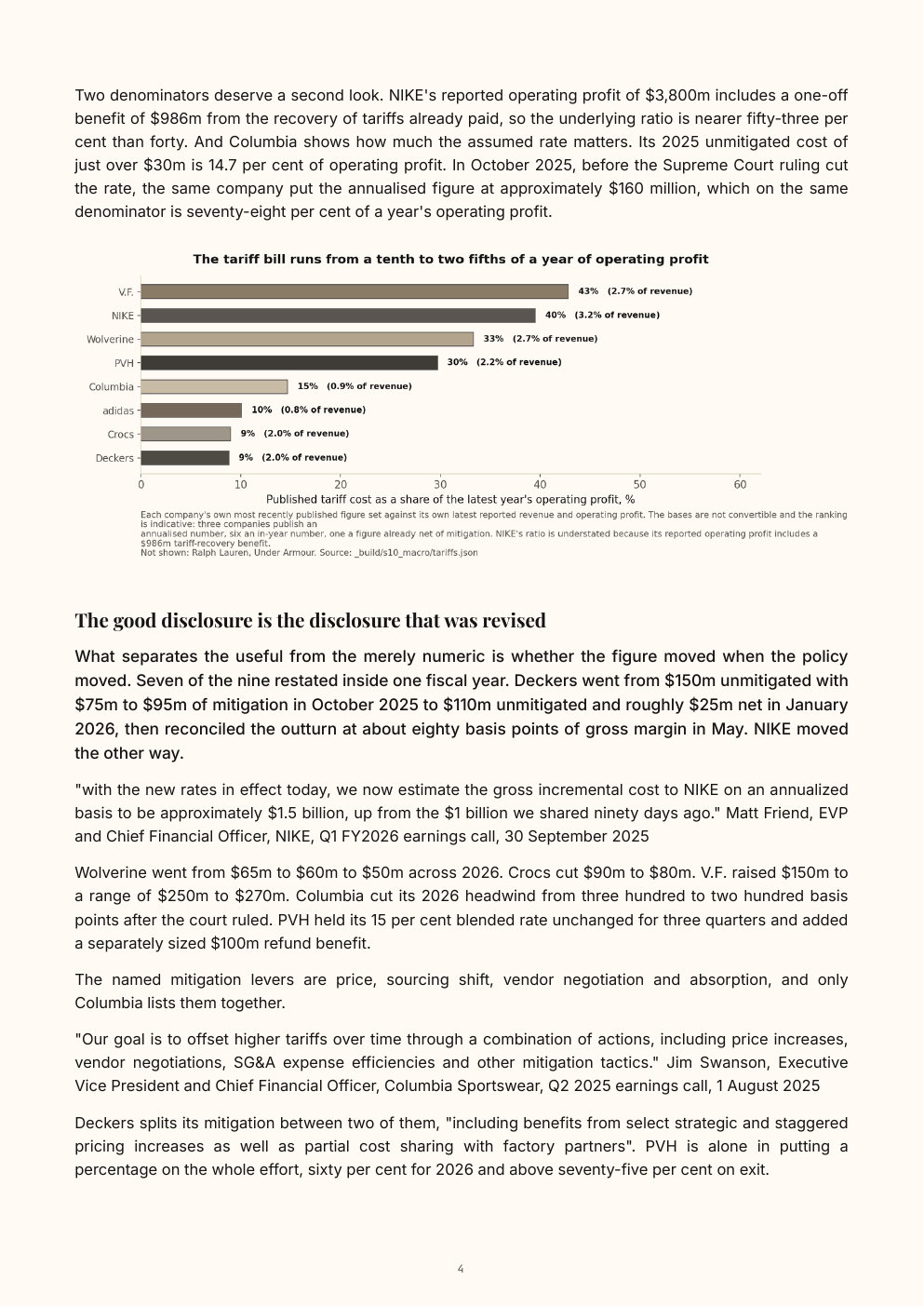
Between April 2025 and February 2026 trade policy did what a decade of investor questions had not, and put a number from outside the business directly onto these companies’ profits. Nine of the ten have now put a currency figure on their tariff bill, and it runs from a tenth of a year’s operating profit at Deckers to two fifths at V.F. Corporation and NIKE.

None of them publishes the exchange rates behind its own currency-adjusted guidance, which is the same disclosure gap in a different currency: a headline number every reader is invited to trust, and no way to test it from outside.

Page from the Global Sportswear and Outdoor Sector Review showing published tariff figures as a share of operating profit.
Each company on its own most recent published tariff figure, in the unit it chose, against its own latest operating profit.
Inside the issue

Eight chapters, one identical page per company

One. Washington now sets the gross margin in this sector: what the outside world is doing, and who is exposed.

Two. The sector grew its way to a lower margin, and borrowed to do it: seven years of shareholder return, taken apart.

Three. Growth and margin are worth the same here, and only two companies took both.

Four. The balance sheet was worth twice the buyback, and the sector spent its attention on the buyback.

Five. What you buy and sell decides which margin and growth you get to have.

Six. The multiple is worth sixty-two points, and three companies show what earns it.

Seven. Fresh guidance no longer moves the shares. Its direction still does: the record of 186 results days.

Eight. Tariffs will be raised on every call this round, and the questions have already moved there.

Notice

Important notice

This review is published by BoardBrain as general commentary on a sector. It is not investment research, it is not a personal recommendation, and it is not an offer or solicitation to buy or sell any security. Nothing in it should be relied on in making an investment decision. Readers who want advice should take it from someone regulated to give it, having regard to their own circumstances.

Every figure is derived from information the ten companies have themselves published, or from market prices, and the sources are set out in the appendix to the issue. Where a figure is recomputed by BoardBrain rather than taken as reported, that is stated. Where an association is not established as a cause, it is labelled as an association. Where the evidence cannot settle a question, the review says so.

As at the date of publication, BoardBrain holds no position in any security mentioned, takes no banking mandates, and received no payment from any of the ten companies in connection with this review. BoardBrain is a research and advisory business. It may in future hold positions in, provide advisory or analytical services to, or receive compensation from any company covered in this issue, and it may publish opinions, ratings or valuation work on them. Any such work will carry its own disclosures. Nothing here should be read as an undertaking that no relationship will arise, and the absence of one today does not imply its absence later.

The absence of ratings, price targets and valuation judgements in this issue is a decision about this issue. It is not a statement about what BoardBrain publishes elsewhere or may publish in future.

What this issue does not contain

This issue carries no ratings, no price targets, no per-share or percentage-of-market-capitalisation figures for any company, and no comparative valuation language. Those are recommendations in substance whatever the disclaimer says, and they would change who may lawfully receive it.

Timing

The state of the world in this document is 28 July 2026. Market data stops on 15 July 2026. One company reported after the corpus cut-off and before publication: Deckers released first-quarter fiscal 2027 results on 23 July 2026. Its page reflects the position as at the fiscal 2026 year end and does not incorporate that release. Four further companies report within days of publication, so the as-at date should be read strictly.

Reproduction

Every figure traces to a saved artifact. Event-level records, per-company benchmark rows, the theme lexicon with its precision scores, the analyst registry, the portfolio-actions ledger, the blind coding records and both coders’ independent codings are all retained. Every quotation in the issue was verified against the corpus by exact string match before publication.
We read the sector so that we can read your company. This is the half we publish.

Request a briefing on your own company All issues